Be(e) Love Series
I’m in a love affair with bees…and here’s why!

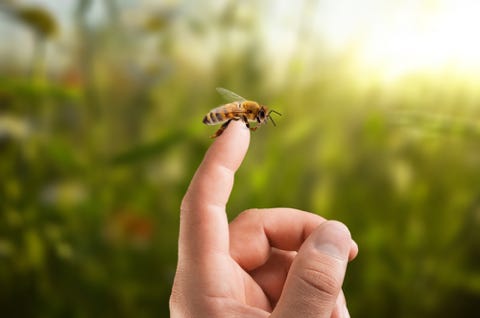
I am deep in the final stretch of my novel, The Humming Bee Prophecy, and bees are everywhere. They buzz in my dreams, in my research, and in the quiet hum of my morning meditations. I have always had a bit of a thing for bees. I think they are beautiful and very magical. I collect bee trinkets and have quite a stash of bee-themed jewellery. And writing a book where bees are the central theme has done something unexpected: it has made me fall even more deeply in love with them. My heart has opened to an attentive love that comes from truly looking.
The more I learn, the more I understand why bees have been sacred for as long as humans have kept records. These are not merely industrious insects going about their business. They are, in every dimension I can find, ecological, biochemical, acoustic, spiritual, expressions of an intelligence that makes our own look rather modest by comparison.
This Be(e) Love Series, through May, is an invitation to fall in love with them, too.
The Original Sacred Insect
Long before we understood the science of pollination, human beings sensed that bees were something other than ordinary. Across civilisations that had no contact with one another, the same intuition kept emerging: bees are messengers, mediators, bridges between worlds.
In ancient Egypt, bees were believed to be born from the tears of the sun god Ra. As those tears struck the desert sand, they transformed into buzzing, golden life. (How gorgeous is that?) The bee hieroglyph signified divine kingship; pharaohs held the title Bee King, linking their authority to cosmic order. Honey was placed in tombs to sweeten the soul’s journey to the afterlife. It did not spoil. It could not be corrupted. For the Egyptians, this made it the food of immortality, a substance existing outside ordinary time.
In ancient Greece, the priestesses of Delphi were known as Melissae: the bees. Prophecy and the bee were considered inseparable. Apollo’s gift of prophecy was said to have first come to him from three bee-maidens. The Melissae of Artemis and Demeter regarded their hives as miniature temples, reflecting cosmic harmony in the comb’s perfect geometry.
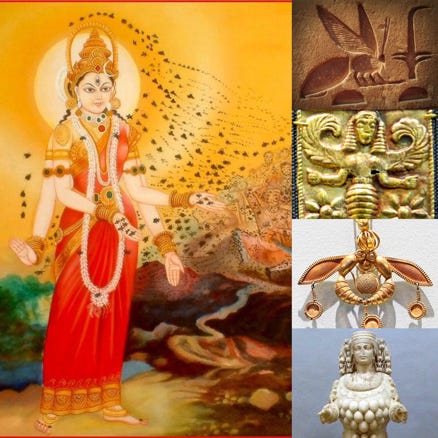
From the Māori people of New Zealand to the Maya of Central America, the San people of southern Africa, and the Norse… wherever we look, the bee is at the sacred centre. The Maya revered the stingless bee Melipona beecheii, using her honey in shamanic rituals and healing, building carved stone hives in sacred groves, and offering chants and incense in her honour. The Norse placed bees in the branches of Yggdrasil, the world tree at the centre of all existence, where they gathered the sacred nectar that fell from its leaves. This was the substance of transformation and divine nourishment. In Sufi mysticism, the hive became a metaphor for the community of souls working in harmony towards union with the divine, with honey representing the sweetness of spiritual ecstasy.
In the Hindu tradition, the Rigveda, one of the oldest texts in any human language, uses bees as metaphors for the soul. The image of a bee gathering nectar symbolises the seeker’s pursuit of wisdom. The goddess Bhramari, an incarnation of Shakti, is the goddess of black bees: a destroyer of demons and an embodiment of divine feminine energy.
Perhaps one of the loveliest spiritual traditions of ‘Talking to the Bees’ comes from my own Celtic roots. The old practice was a cherished folk custom found in parts of England, Ireland, Wales, Germany, France, and later in rural parts of the United States. It arose from the belief that bees were not merely insects, but intelligent household companions connected to the spirit of the home, the land, and the family’s fortunes. A beehive was often regarded almost as a member of the household.
When an important life event occurred, especially a death, but also births, marriages, departures, or major changes, the keeper of the bees would go to the hive and formally tell them the news.
The belief was that if bees were not informed, they might become distressed, stop making honey, abandon the hive, sicken, or die. In older worldviews, bees were seen as creatures who understood human emotion and social order. Their loyalty had to be maintained through courtesy.
Spiritually, the custom carries a beautiful symbolic truth: when transformation happens in a household, even the smallest and busiest parts of life must be gently brought along.
Bees and honey are also prevalent in different forms of magic, such as Hoodoo and Root Magic. We will be exploring these traditions in our upcoming Bee Magic Workshop, May 31st in Singapore.
What did all these cultures intuitively know that we are only now beginning to articulate? They knew that bees are not separate from the sacred order of things. They are, in some sense, its emissaries.
The Matriarchy in Miniature
It’s worth noting that the predominant societal structure of the ancient world was matriarchal. In our current world, raging with male leaders, conflict, polarised wealth, gender inequality and individualistic mindset, bees remind us of a way of existing that seems far more attractive. I want to say something about the hive as a model of society, because it is one our own world could learn from.
The bee colony is, at its heart, a matriarchy. The queen does not rule by force or decree. She rules by presence. Her pheromones move through the hive like living music, harmonising the behaviour of up to 60,000 individuals into a single coherent intelligence. Remove her, and the hive knows within hours. They will immediately begin raising a new queen because they know the colony is more important than any of its members.
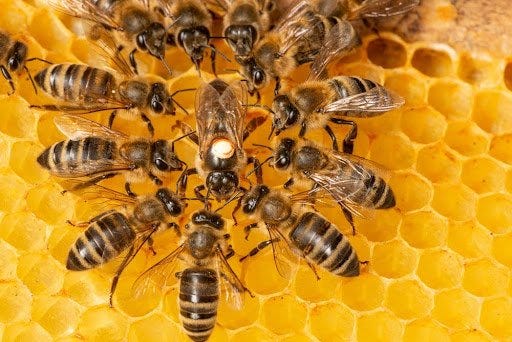
The worker bees are all female. They do everything: forage for nectar and pollen, care for the larvae, regulate the temperature of the hive by fanning their wings or vibrating their bodies, make wax, guard the entrance, and produce honey. They communicate through the famous waggle dance, a form of abstract, symbolic language in which a forager returning from a productive patch of flowers performs a figure-of-eight to convey precise direction and distance to her sisters. It is a living language.
The drones, the males, exist for a single purpose: to mate with a new queen. Once they have mated, they are gently expelled from the hive before winter. The colony cannot afford to feed those who do not contribute to its survival.
This is a community that has solved, through millions of years of evolution, what we humans are still struggling to achieve: a society in which every member works for the flourishing of the whole, in which intelligence is distributed rather than concentrated, and in which life itself, the hive’s warmth, its young, its future, is the sacred project everyone is devoted to.
Join me for some Bee-Loving in May!
Over May and June, we are supporting our planet’s bees. We will be donating to Women for Bees alongside our other Earth-Loving causes.
You can contribute through the following:
In Singapore:
Join a Dawn Dreaming meditation: Friday mornings in nature at sunrise. 100% donated
Come along to my Bee Magic Workshop: Sunday, May 31st 2-4 pm. 100% net proceeds donated (less venue and materials)
From anywhere:
Book a session with me – energy healing, coaching, psychic mediumship. 10% of session fees donated through May & June
Buy my book Spirited: A guide to your innate spiritual design to transform your life. 100% book royalties received for May & June donated
Follow me on Instagram for some gorgeous bee-giveaways
Love,
Dani
Please visit my Spirited Living to explore courses and helpful content to guide you on your path to healing, self-discovery and mindful living. You could also explore a spirited life further in my book, ‘Spirited – A guide to your innate spiritual design to transform your life’, which is now available. See stockists here.
If you enjoyed this post and would like to share it, I request that you please credit Danielle Van de Velde as the author. I do not authorise repurposing or republishing without my written permission. You may email me for the same.